

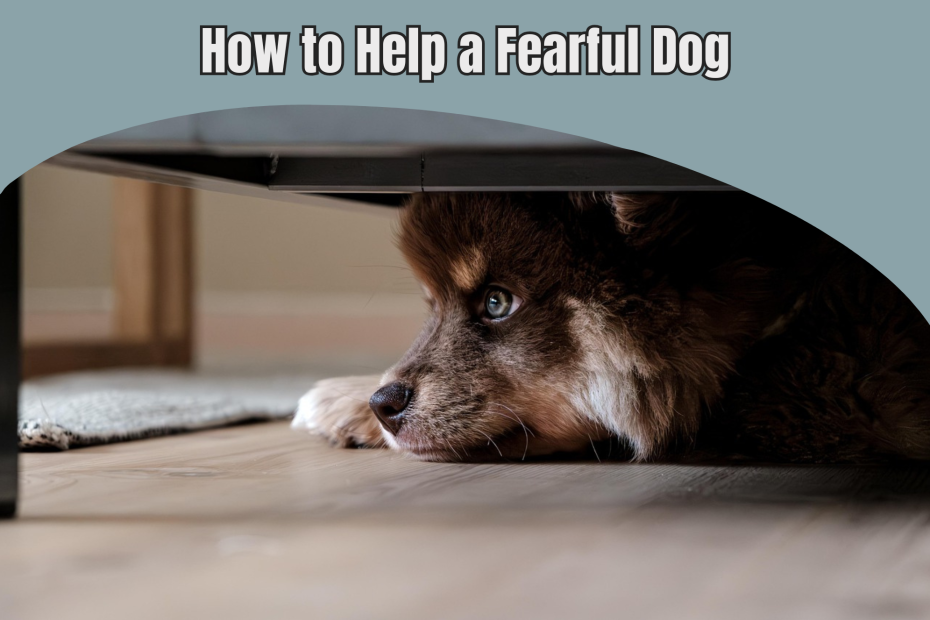
Sometimes, Our Dogs are Scared and Need Help
If you are wondering how to help a fearful dog, it’s probably because you’re leaving in a scenario I’ve seen a thousand times.
You reach for your shoes. Your dog’s whole body changes. They stop chewing. They start shadowing you. Maybe they whine. Maybe they pace. Maybe they shove their head under your hand like, “Please don’t do this.”
Or the trigger isn’t you leaving. Maybe it’s the vacuum. Or the doorbell. Or a stranger who makes eye contact. Or another dog across the street. Or thunder that hasn’t even cracked yet, but your dog is already scanning the house like it’s about to fall apart.
And if you’re honest, there’s a moment where you think:
“I don’t know what to do anymore.”
If that’s you, I want to say this plainly: you’re not alone, and your dog isn’t being “bad.” A lot of what people call “dog anxiety” is really fear-driven survival behavior playing out in everyday life.
I’m a science-based, force-free dog trainer in Beloit, Wisconsin, and a big part of my work is helping families navigate fearful, anxious behavior in a way that’s practical and human, because when your dog is scared, everyday life can get hard fast.
Anxiety and fear in dogs can look like stubbornness, defiance, or drama—especially when we’re tired and overwhelmed. But most of the time, what you’re seeing isn’t your dog trying to control you.
It’s your dog’s nervous system trying to protect them.
Think about it this way: if your dog’s brain believes something is dangerous, their job isn’t to be polite. Their job is to survive.
So in this article, I want to do two things:
- Help you understand what’s happening inside your dog (including the brain stuff, but in normal human language).
- Give you practical steps that actually help—without fear, force, or “just let them get used to it.”
And if the fear you’re dealing with is specifically about your dog being alone, we’ll talk about that too—because separation anxiety is its own category of hard.
Fear vs. Anxiety: Similar, but Not Identical
People use “fear” and “anxiety” like they’re the same thing. They’re related, but it helps to tease them apart.
Fear is the response to a threat that feels present: that thing is here right now. It looks like a startle, a freeze, or an immediate reaction to a trigger.
Anxiety is the anticipation of a threat: that thing might happen. It looks like scanning, pacing, being unable to settle, reacting “early,” or spiraling before anything even happens. That’s why some dogs panic when you reach for your keys. They’re not reacting to the act of leaving. They’re reacting to the pattern that predicts leaving.
And that’s also why you can have a dog who seems “fine” one moment and then melts down the next. Their nervous system isn’t always responding to what’s happening. Sometimes it’s responding to what they expect is about to happen.
The Neuroscience: Your Dog Has a Smoke Alarm, and It Might be Too Sensitive
Here’s the simplest way I know to explain canine fear and anxiety.
Your dog has an internal alarm system. Its purpose is good: it keeps them alive. But some dogs have alarm systems that are too sensitive, too loud, or too quick to activate.
The part of the brain we often talk about here is the amygdala—the threat detector. It’s fast. It’s not interested in nuance. It’s like a security guard who has one job: spot danger and hit the panic button.
When your dog perceives a threat (or predicts one), the brain and body shift into survival mode. This is where you’ll hear terms like “fight, flight, or freeze,” but you don’t need fancy vocabulary to recognize it:
- Some dogs move toward the scary thing with barking and lunging (fight).
- Some try to escape, hide, or bolt (flight).
- Some go still, stiff, or “shut down” (freeze).
All of that is the nervous system trying to keep the dog safe.
And then the body chemistry joins in. Adrenaline ramps things up quickly: heart rate, muscle readiness, alertness. Cortisol can keep the dog on edge longer, even after the trigger is gone.
In a balanced system, these rise and fall. The dog recovers. But in an anxious dog, however, the recovery can be slow, or the system can activate so often that the dog never really returns to baseline.
So, if you ever see training fall apart when anxiety shows up, this is why. Remember, when the brain is in survival mode, it’s not in learning mode.
I’m not making an excuse for the dog here. That’s just biology.
Have you ever tried to reason with someone mid-panic attack? If so, then you already know how this works. You can’t teach algebra in the middle of a fire drill. You first have to get everyone safe first, then move forward from there.
Why Your Dog Ignores Treats (and Why That Matters)
It’s common for people to tell me that they can’t work with their anxious or fearful dog because they won’t take the treats they normally love. This is one of the clearest signs that a dog is overwhelmed.
A dog who is under threshold—meaning they are aware of a trigger but still regulated emotionally—can usually eat. A dog who is over threshold often can’t. Their body is saying, “This is not snack time. This is survival time.”
So if your dog “won’t take treats” around the scary thing, that’s not stubbornness. It’s information. It means the trigger is too intense, too close, too sudden, or too long.
And that’s not the moment to push harder. That’s the moment to make the situation easier.
Need hands-on help in Beloit?
If you’re in Beloit, Wisconsin (or nearby in the Stateline area), and you want a personalized plan for fearful dog training, you don’t have to piece this together alone. I offer coaching that’s grounded in behavior science and built around your dog’s specific triggers, thresholds, and daily routine. Start the ball rolling by setting up a free 30-minute phone assessment.
Step Zero: Check for Pain and Medical Contributors
Before we treat anxiety as “just behavioral,” we have to be responsible.
Pain can make dogs more reactive, more avoidant, more clingy, more sensitive to touch, less tolerant, and less able to settle. Gastrointestinal issues can increase stress. Hormonal changes, sensory decline, and neurological issues can also play a role.
If your dog’s anxiety came on suddenly, escalated quickly, or is paired with physical changes (sleep, appetite, movement, elimination), it’s worth a veterinary conversation.
This isn’t you being paranoid. It’s you being thorough.
How to Help a Fearful Dog: Change the Emotion First,Then the Behavior
Here’s the core of what I want you to take from this article:
Anxiety isn’t first and foremost a training problem. It’s first and foremost an emotional problem.
So our job is not to “correct” fear out of a dog. Our job is to help the dog’s brain and body learn something new: “This is safe. I can handle it. I recover.”
That happens through two big strategies.
The first is management—preventing the dog from practicing panic. This is incredibly important because it’s how you stop the fear pathways from getting stronger every day.
The second is emotion work—helping the dog to process their world differently. This is where the real healing happens.
Management: Stop Rehearsing Fear
If a dog is repeatedly thrown into situations that overwhelm them, their nervous system gets better at being overwhelmed. That’s not because they’re dramatic. It’s because brains learn through repetition.
So management means you make smart adjustments so your dog isn’t constantly practicing fear.
This generally looks like simple environmental changes. For example…
- Blocking window access for dogs who panic at outdoor activity.
- Using white noise for sound-sensitive dogs.
- Choosing quieter walk routes.
- Skipping the chaotic pet store “socialization” trip.
- Giving your dog a safe space where nobody bothers them.
This is the part where some people worry they’re “coddling.” I don’t see it that way at all. Think of it this way…
If your dog had an injured leg, you wouldn’t force them to run to “toughen up.” You would change the conditions so healing can happen.
That’s management.
Emotion Work: How We Actually Change Fear
When I work with emotions, I focus on how the emotions are made.
- The dog sees a situation unfold.
- In order to respond to the situation, the dog looks to its history of similar situations to form a prediction.
- That prediction generates an emotion (which is a statement of meaning).
- That prediction fueled by the emotion generates behavior.
If we want to change the emotion, we need to change the prediction. And we do that by generating alternative, positive experiences in the dog’s history.
But where do you start?
This is where a lot of people go wrong—not because they don’t care, but because they don’t realize how small the starting point needs to be.
If your dog is afraid of strangers, you don’t start with strangers. You start with people your dog knows so they can learn what to do as they progress through the training until they are working with strangers.
It’s not glamorous. It can be annoyingly slow.
But it works.
And you can tell you’re doing it right when your dog stays under threshold—meaning they can still eat, still think, and still recover.
Practical, Real-Life Examples
This is what fearful dog training looks like in real life: not forcing bravery, but building safety in small, repeatable steps. Let’s walk through some situations people deal with every day.
In my work with clients here in the Beloit, WI area, these are the same fear patterns I see again and again, and the same few principles that consistently move the needle.
Noise Fear (Thunder, Fireworks, Random Bangs)
If your dog panics at loud sounds, your first job is relief. Not training, but relief.
A safe den, sound masking, closing blinds, staying close if your dog seeks contact—those are all reasonable supports.
Training comes when the dog is not already flooded. That might look like very low-volume sound recordings paired with really good food, with sessions so short they almost feel silly. The goal is not endurance. The goal is rewiring your dog’s brain so “that sound predicts good things”.,
Stranger Fear or Reactivity on Walks
If your dog barks or lunges, I want you to consider that many dogs are not being “aggressive” in a strategic way. They’re creating distance. Barking works because it makes the scary thing go away.
So the first intervention is often distance that you create intentionally rather than your dog having to create it explosively.
Then you train at a distance where your dog can notice the trigger and remain regulated. Over time, you close the gap slowly, not because you’re forcing bravery, but because the dog is learning safety.
If you would like help with this, consider my extremely affordable package geared toward reactivity.
If you want to talk with me about your dog’s reactivity, feel free to set up a free 30-minute phone assessment and talk with me on my dime.
Grooming and Handling Fear
A lot of dogs hate nail trims, brushing, ear cleaning, largely because they feel trapped. If you’ve ever held a dog down to “get it done,” you’ve probably seen the aftermath. Next time, the dog was even harder to handle.
Instead, we teach cooperative care: tiny exposures paired with reinforcement, with the dog having ways to communicate “pause.” That’s not anthropomorphizing. It’s consent-based handling. And it tends to create more cooperation, not less.
Now, Let’s Talk about the Big One: Separation Anxiety
Separation anxiety deserves special attention because it is not simply “boredom” or “bad manners.”
Generally speaking, separation anxiety is panic.
Not inconvenience. Not protest.
Sheer panic.
And once you see it that way, the approach becomes clearer: you don’t punish panic out of a nervous system.
You treat it. You help your dog to heal.
What Separation Anxiety Looks Like in Real Life
You might see…
- nonstop vocalizing
- frantic pacing
- drooling
- destruction near exits
- escape attempts
- accidents
- refusal to eat after you leave
- even self-injury
And the hardest part is this: many dogs with separation anxiety look completely normal when you’re home. So many people don’t realize how intense it is until they see a video, a neighbor complains, or damage happens.
The Brain Piece, in Plain Language
Some dogs experience isolation as unsafe. Their threat circuitry activates when their person is gone, and the body responds like it would to danger.
That’s why advice like “just leave them to cry it out” can backfire. You’re not teaching the dog to self-soothe. You may be teaching the dog that being alone is terrifying and unavoidable.
That’s not resilience. That’s learned helplessness, which only escalates the panic.
Why the “Common Tips” Often Fail
A tired dog can still panic. A stuffed Kong can still be ignored if fear is high. A crate can help some dogs, but for others it becomes a panic box. And punishment after the fact doesn’t teach anything because the dog’s fear-induced behavior happened hours ago.
Separation anxiety requires a plan that respects nervous system reality.
What Actually Works (and What People Underestimate)
The training process for separation anxiety is, at its core, very simple:
- You help the dog learn the foundational behaviors needed to progress
- You help the dog become comfortable with your absence
- You leave for short durations your dog can handle
- You return before distress
- You gradually build
But “simple” doesn’t mean easy, because the details matter.
When I work with dogs and separation, I literally start with 1 second and move up gradually from there. And if you jump past what the dog can handle, you get a setback. Remember, if you experience a setback, it doesn’t mean your dog is being stubborn. It’s proof the nervous system got overwhelmed.
Think of it like physical therapy. If the tissue can’t bear load yet, you don’t increase load (so don’t get impatient). Instead, you increase it when the body has adapted and is ready for the increase.
And you measure progress not by perfection, but by recovery.
- Does your dog recover faster?
- Can your dog eat sooner?
- Can your dog stay settled longer?
- Are stress signals lower?
That’s what change looks like.
A Gentle Word about Support (Because This is Exhausting)
Living with an anxious dog (especially a dog who can’t be alone) can reshape your entire life. Your schedule becomes a puzzle. Your nervous system gets tired too. You start anticipating the next problem the way your dog does.
So if you feel trapped, you’re not weak.
You’re human.
And you don’t have to solve this with random internet advice scattered across a dozen tabs. You deserve a structured plan.
Where My Separation Anxiety Starter Pack Fits In
If your dog’s biggest struggle is what happens when you leave, that’s exactly why I created my Separation Anxiety Starter Pack.
Most people don’t need more tips. They need a step-by-step process that helps them:
- figure out their dog’s true “starting point” (without guessing)
- build alone time in a way that prevents panic rehearsal
- understand what to do when progress stalls
- troubleshoot the common curveballs that show up in real homes
- stay consistent without feeling like your life has to stop forever
It’s designed to be supportive and practical because this is one of those issues where “do your best” isn’t specific enough. You need clarity.
If separation anxiety is your dog’s primary challenge, the Separation Anxiety Starter Pack is the most direct next step I can offer you. Start the conversation by setting up a free 30-minute phone assessment.
And, if you are strapped for cash and can’t afford even my discount rates, I’ve still got you covered. That’s why I created my Separation Anxiety DIY Program.
The Takeaway I Want You to Remember
Fear and anxiety aren’t character flaws.
They’re nervous system states. They’re learned patterns. They’re survival strategies.
And the way through is not force. It’s not flooding. It’s not “making them tough.” It’s compassion plus science:
- Make the world easier while your dog is learning.
- Train under threshold.
- Pair triggers with good outcomes.
- Measure recovery.
- And build calm like a skill.
Your dog can change. Their brain can change.
And if you’re struggling, you don’t have to do it alone.
Remember, I’m a force-free dog trainer in Beloit, Wisconsin, serving families in the surrounding Stateline area. If your dog is struggling with fear or anxiety, I can help.
And if you aren’t in the area, I can work with you remotely through my Online Dog Training Anywhere option that allows you to take advantage of my economy pricing wherever you are in the world.
If you want to find out how I can help you, just schedule a free 30-minute phone assessment on the calendar below.
Follow Puppy Tutor Dog Training on Facebook for daily posts related to dog training.

Hi! I’m Bo McGuffee, owner of Puppy Tutor Dog Training. My mission is to make human dog training accessible and affordable.
If you are looking for a science-based and compassionate alternative to the more aggressive training styles out there, then you’ve found the perfect dog trainer for you and your dog.
Since I also work remotely, I can help you train your dog no matter where you are, and you get to take advantage of my economy pricing for private lessons.
Interested? Sign up on my call calendar for a free 30-minute assessment.